Use case
Read a patient's whole history in an emergency
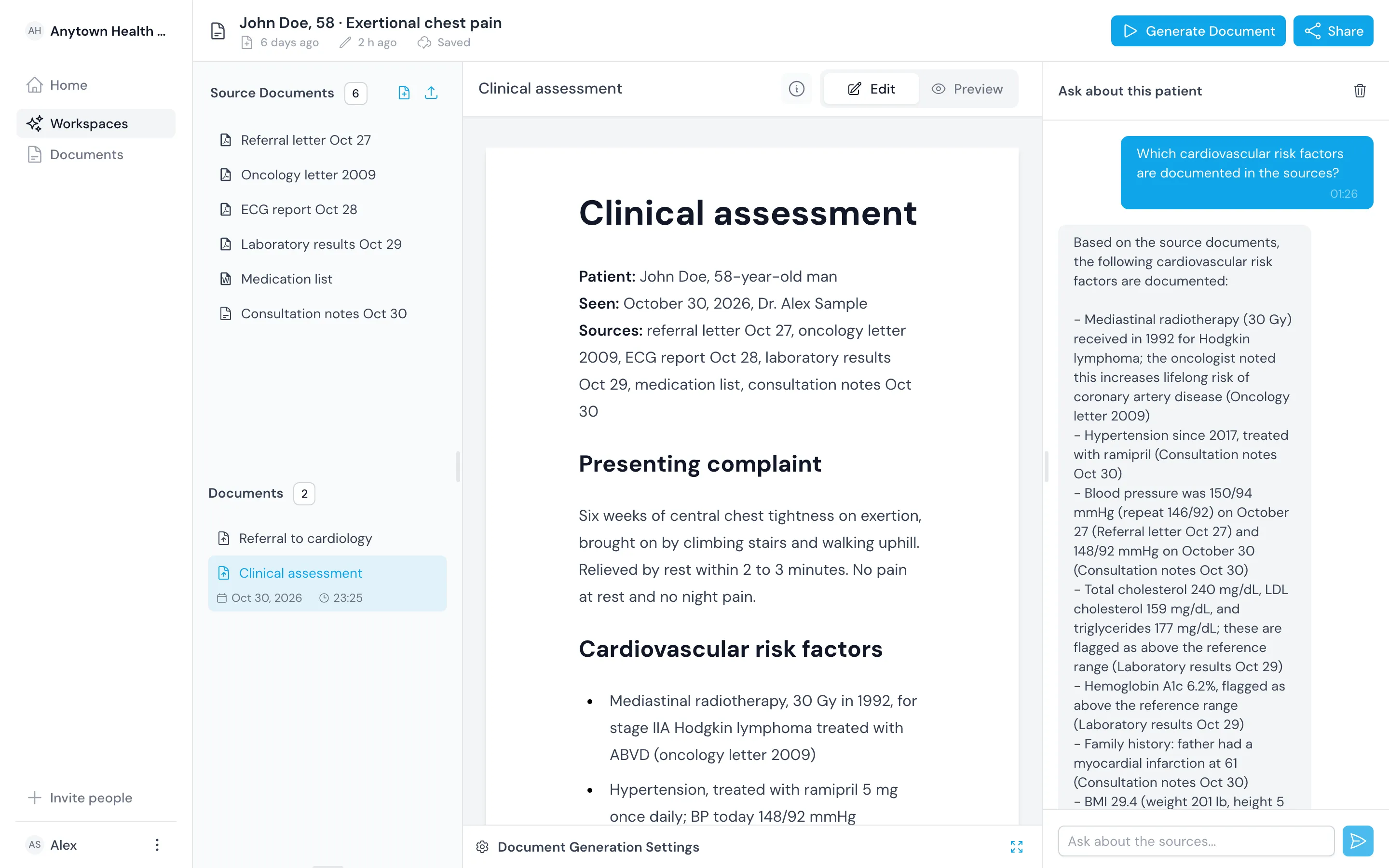
When a patient arrives with a thick history and no time to read it, load the records into one workspace. Ask for the facts that change the next decision, and open the source behind each one.

The situation
Start from a real clinical day
At 2 a.m., Richard Roe, 74, arrives by ambulance, breathless, confused and too unwell to give a history. His daughter brings a folder of letters, and his records from two other hospitals arrive as a 300-page export.
Dr. Taylor Test is the doctor on call. Somewhere in 15 years of discharge summaries, clinic letters, operation notes and results are the facts that decide the next hour. No one can read 300 pages while treating a patient.
When he moves to intensive care, the questions keep coming: what his kidneys were like before, whether this has happened before, what he has said about limits on treatment. Every doctor who takes over asks the same workspace.
Add these sources to the workspace
- 1
Discharge summaries and clinic letters from three hospitals, exported as PDFs
- 2
The patient's own portal download, or the paper letters his family brought, photographed as images
- 3
Previous echocardiogram, imaging and anesthesia reports
- 4
Lab results exported to Excel
- 5
The current medication list and the ambulance handover notes
What you ask
Ask for what you need in your own words
List his allergies, blood thinners and current medications, his usual kidney function, his last ejection fraction, any airway problems in previous anesthesia, and any advance directive or limits on treatment, with the source of each.
See the facts that change the next decision
You get a penicillin anaphylaxis from a 2016 discharge summary, apixaban 5 mg twice daily from the latest clinic letter, and a difficult airway recorded in a 2019 anesthesia note. Each line names its source and date.
See his usual baseline
You get his usual creatinine and an ejection fraction of 35% from the 2023 echocardiogram, so you can compare tonight's results with his normal.
See his wishes
You get the advance directive he signed in 2024, which declines intubation but accepts noninvasive ventilation, and the name of his health care proxy.
Keep asking in intensive care
The ICU team asks the same workspace about earlier admissions, cultures and how he responded to treatment, and drafts each shift handover from it.
Before you use it
Check these before you file anything
You edit every draft and make every clinical decision. Check each answer against the source it names.
- 1
Open the cited source for any fact you act on, and confirm it with the patient, family or prescriber when you can
- 2
Treat a fact the sources do not mention as unknown, never as absent
- 3
Follow your department's protocols, and use the answers to support your judgment
Questions
Frequently asked questions
How do the records get into the workspace?
Upload what you have: PDFs exported from other hospitals' systems, the patient's own portal download, photographed or scanned paper letters, and lab exports. Workup Desk does not connect to record systems yet.
What if the records are incomplete?
Each answer names its sources and says when the sources do not mention something. An allergy missing from the sources does not mean the patient has none.
Who else can see the workspace?
Only the colleagues in your organization you share it with, as viewer or editor. The ICU team picks up the same workspace when the patient moves.
More
Keep exploring
- Prepare for a new patient with a thick referral
A cardiologist adds a referral and years of letters and results to one workspace, asks for the relevant history and results with dates, and checks each one before clinic.
- Review new results against the history
A family physician adds a batch of new lab results next to earlier ones and the visit note, asks what changed and what bears on the complaint, and checks units and dates.
- Check a referral has what the specialist needs
A family physician asks what a cardiology referral for palpitations needs that the sources do not yet contain, fills the gaps, then drafts the referral letter and edits it.
Workup Desk is not a medical device. No regulator, including the FDA, has cleared or approved it for diagnosis, treatment decisions, triage or time-critical decision support. It answers from the documents you add, and its answers can be incomplete or wrong.
Do not rely on Workup Desk as your only source of information in an emergency. Keep access to the original records and your usual systems. The service can be slow or unavailable, very large record sets take longer to process, and it does not monitor patients or raise alerts.
The clinician remains responsible for every clinical decision. Follow your institution's protocols, and check any fact you act on against its source.
Add identifiable patient data only after your organization has signed a data processing agreement or business associate agreement with us.