For primary care physicians
Assess the patient in front of you from all of their records
A primary care visit is short and the file is long. Put the letters, results and your notes in one workspace, ask what you need to know and draft the referral from the same sources.

Today
What slows you down in a short appointment
You piece the history together from many letters
You find part of the story in each hospital letter, old referral and result, all in different places.
You spend longer on the referral than the visit
A clear referral means rereading everything you read before the patient came in.
You start each follow-up from memory
When the patient comes back, you rebuild what happened from scattered notes.
With the workspace
Six jobs you hand to the workspace
Each one used to mean rereading the file. Now you ask or draft from it.
Gather the history
Upload letters and results into one workspace per patient.
Find one value
Ask for the last LDL or when a drug was started, and see the source.
Draft the assessment
Start from a draft with history, findings, differential and plan.
Write the referral
Draft a referral that states your question for the specialist.
Explain the plan
Draft a summary the patient can read at home.
Pick up at follow-up
Add new results to the same workspace and ask what they show.
One patient
Refer to cardiology from the first visit
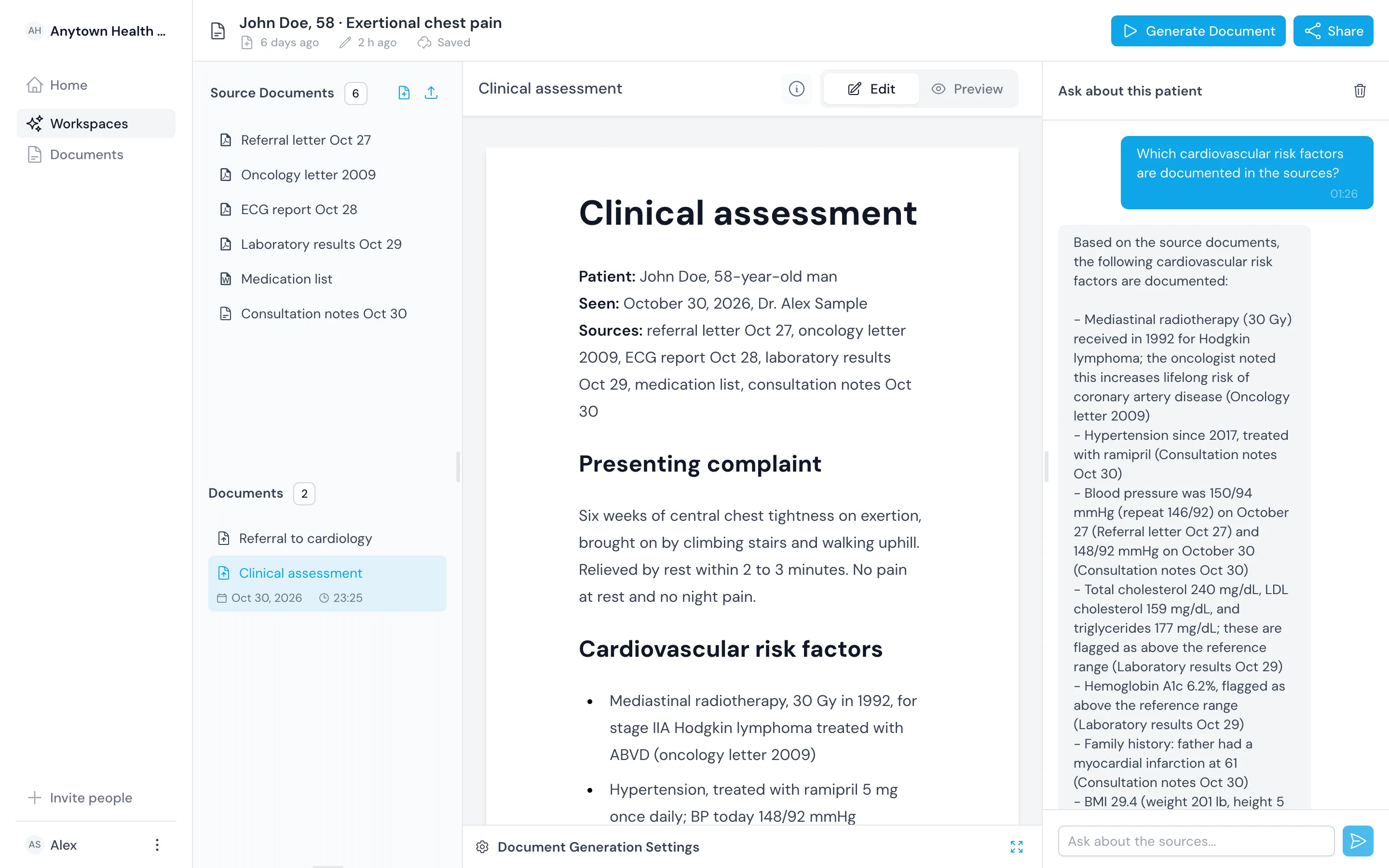
John Doe, 58, has had chest tightness on exertion for six weeks. His workspace holds the practice notes, an ECG report, his lab results and a 2009 oncology follow-up letter.
Ask what the record shows
The chat lists his risk factors with their sources: hypertension on ramipril 5 mg, a father with a heart attack at 61, and mediastinal radiotherapy for Hodgkin lymphoma in 1992, found in the 2009 oncology letter.
Draft the assessment
You draft from BP 148/92, a soft ejection systolic murmur, an ECG in sinus rhythm without ST changes, hs-troponin T 6 ng/L and LDL 159 mg/dL, and record typical angina as your assessment.
Write the referral
You request CT coronary angiography and an echocardiogram, draft the cardiology referral from the same workspace, edit it and export it as PDF.

Questions
Frequently asked questions
Does it work with our practice record system?
No. It has no integration with your record system. Upload the documents you export from it and file the finished letter back as PDF or Word.
Will it write the referral for me?
It drafts one from the sources in the workspace. You edit it, and you decide what goes to the specialist.
What should I add before I start?
The referral or the reason for the visit, recent letters, results and your own notes. You can add more at any time.